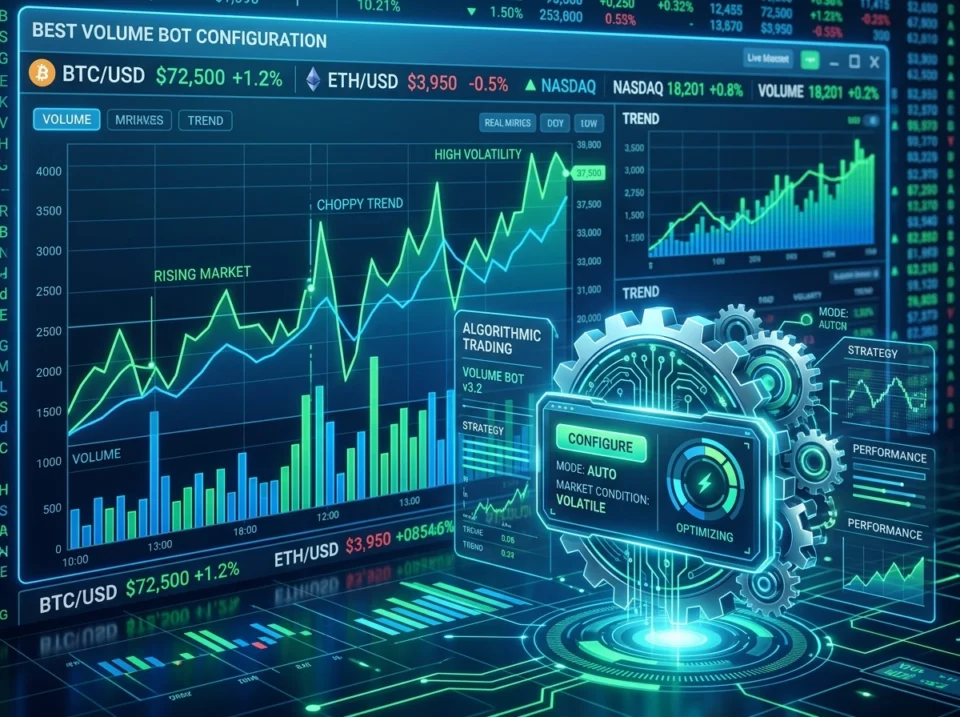
Volume bots have become essential tools for traders and project teams operating in fast-moving crypto markets. These automated programs generate trading activity that boosts visibility, improves chart aesthetics, and helps tokens stand out on busy platforms. But here’s the catch: a volume bot that performs brilliantly in one market will flop in another if you leave its settings untouched.
Markets shift constantly. A configuration tuned for a roaring bull run can drain your budget during a quiet, sideways stretch. To get real value from automation, you need to match your bot’s behavior to the conditions in front of you. This guide walks you through exactly how to do that.
What a Volume Bot Actually Does
At its core, a volume bot executes buy and sell orders automatically across one or more wallets. The goal is to create consistent, natural-looking trading activity around a token. This serves several purposes:
- Visibility: Higher volume pushes tokens up trending lists and trackers.
- Liquidity signals: Active markets attract organic traders who feel more confident jumping in.
- Chart health: Steady transactions keep price charts looking lively rather than flat.
The key word is natural. A poorly configured bot produces robotic, repetitive patterns that savvy traders and platform algorithms can spot instantly. Smart configuration is what separates effective tools from obvious manipulation.
Reading Market Conditions First
Before touching a single setting, identify what kind of market you’re working in. Each condition calls for a different approach.
Bullish Markets
Prices trend upward, sentiment runs high, and organic buyers flood in. Volume comes easily here, so your bot’s job is to amplify momentum rather than carry the whole load.
Bearish Markets
Prices fall, fear dominates, and traders pull back. Activity dries up. Your bot needs to maintain a baseline of life on the chart without burning through funds chasing a falling price.
Sideways or Ranging Markets
Price bounces within a tight band with no clear direction. These periods are common and often the longest-lasting. Steady, measured volume keeps the token relevant while you wait for a breakout.
High Volatility Markets
Sharp swings happen in both directions. Slippage becomes a real risk, and poorly timed trades can cost you. Caution and tight controls matter most here.
Core Parameters You Need to Master
No matter the market, these settings form the backbone of any solid configuration. Understanding what each one does lets you adjust quickly when conditions change.
- Trade frequency: How often the bot places orders. Higher frequency creates more volume but increases costs and detectability.
- Volume thresholds: Target volume levels the bot aims to hit within a set period.
- Slippage tolerance: The maximum price movement you’ll accept on a trade. Too tight and trades fail; too loose and you lose value.
- Wallet distribution: How many wallets the bot uses and how it spreads activity across them. More wallets mean more organic-looking behavior.
- Order size variation: Randomizing trade amounts to avoid obvious patterns.
- Timing randomization: Adding irregular gaps between trades so activity doesn’t look mechanical.
Configuration Strategies by Market Condition
Now let’s put those parameters to work. Here’s how to tune your setup for each scenario.
Configuring for Bullish Markets
When momentum is on your side, lean into it without overspending.
- Trade frequency: Moderate. Organic buyers handle much of the volume, so you supplement rather than dominate.
- Volume thresholds: Set higher targets to match the elevated activity, keeping your numbers credible.
- Slippage tolerance: Slightly loosen it. Fast-moving prices mean tight limits cause failed trades.
- Order sizes: Vary widely, including a few larger buys to reinforce upward pressure.
- Wallet distribution: Spread across many wallets to mirror genuine crowd behavior.
The aim is to ride the wave while keeping your footprint subtle. Overdoing it during a bull run wastes resources you’d rather save for slower times.
Configuring for Bearish Markets
Survival mode. Protect your budget while keeping the token visibly alive.
- Trade frequency: Low to moderate. Resist the urge to “prop up” a declining price with heavy buying.
- Volume thresholds: Reduce targets. Forced high volume in a dead market looks fake and drains funds fast.
- Slippage tolerance: Keep it tight to avoid getting filled at unfavorable prices during downward spikes.
- Order sizes: Smaller and consistent, favoring frequent small buys over large ones.
- Wallet distribution: Maintain rotation so the chart shows ongoing participation rather than a single desperate buyer.
The goal is patience. A bear phase eventually ends, and a token that stayed active throughout is positioned to bounce back.
Configuring for Sideways Markets
Consistency wins in ranging conditions. You want a steady heartbeat on the chart.
- Trade frequency: Steady and regular, with timing randomized to avoid robotic patterns.
- Volume thresholds: Moderate and stable. Predictable daily volume builds trust over time.
- Slippage tolerance: Standard settings work well since price moves little.
- Order sizes: Balanced buys and sells to keep price inside the range without forcing a breakout.
- Wallet distribution: Rotate evenly so no single wallet looks dominant.
This is where many projects spend most of their time, so a reliable sideways configuration is arguably the most valuable one to perfect.
Configuring for High Volatility Markets
Defense first. Sharp swings punish careless settings.
- Trade frequency: Lower than usual. Fewer trades reduce exposure to sudden reversals.
- Volume thresholds: Conservative. Chasing volume during wild swings is a quick way to lose money.
- Slippage tolerance: This is the critical setting. Keep it controlled but realistic so trades execute without disastrous price slippage.
- Order sizes: Smaller across the board to limit the impact of any single bad fill.
- Timing: Add longer, randomized gaps to wait out the worst of the chaos.
When volatility calms, you can shift back toward a bullish or sideways configuration depending on where price settles.
Maximizing Performance on Pump.fun
Platforms like Pump.fun have their own quirks, fast token launches, tight-knit communities, and algorithms that reward genuine-looking activity. Choosing the best volume bot for the platform makes a real difference in results. Keep these tips in mind:
- Prioritize natural patterns. Pump.fun audiences move fast and spot artificial activity quickly. Randomized timing and order sizes are non-negotiable.
- Mind transaction costs. Solana fees are low but add up across thousands of trades. Match frequency to your budget.
- Use ample wallet rotation. More wallets create a believable sense of organic interest.
- Time your pushes. Coordinate heavier volume with announcements, listings, or community events for maximum effect.
- Monitor and adjust live. Market conditions on new tokens can flip in minutes. Watch your bot and tweak settings as the situation evolves.
A Few Best Practices Worth Remembering
Regardless of platform or condition, these habits keep your automation effective:
- Test small first. Run a conservative setup before scaling up to confirm everything behaves as expected.
- Review results regularly. Check whether your volume looks natural on the chart and trackers.
- Stay adaptable. No single configuration works forever. The best operators adjust constantly.
- Keep records. Note which settings worked in which conditions so you can repeat success.
Conclusion
There’s no universal “perfect” setup for a volume bot. The real skill lies in reading the market and matching your configuration to it. Bull runs call for amplifying momentum, bear phases demand conservation, sideways markets reward steady consistency, and volatile conditions require careful defense.
Master the core parameters, trade frequency, volume thresholds, slippage tolerance, wallet distribution, and order variation, and you’ll be able to pivot smoothly as conditions shift. Pair that flexibility with platform-specific awareness, and your bot becomes a genuine asset rather than a budget drain. Start small, watch closely, and adjust often. That’s how you get the most out of automation in any market.
