You’ve probably heard the term “tech stack” thrown around in startup pitches, developer forums, or job descriptions. But what does it actually mean—and why does it matter so much?
Whether you’re launching a product, hiring engineers, or just trying to understand how software gets built, knowing how to think about tech stacks is genuinely useful. This guide breaks it all down: what a tech stack is, what it’s made of, how to choose the right one, and what the most popular stacks look like today.
What Is a Tech Stack?
A tech stack is the combination of programming languages, frameworks, libraries, databases, and tools used to build and run an application. Think of it as the full recipe for how a piece of software is made—every ingredient has a role, and the way they work together determines how the final product performs.
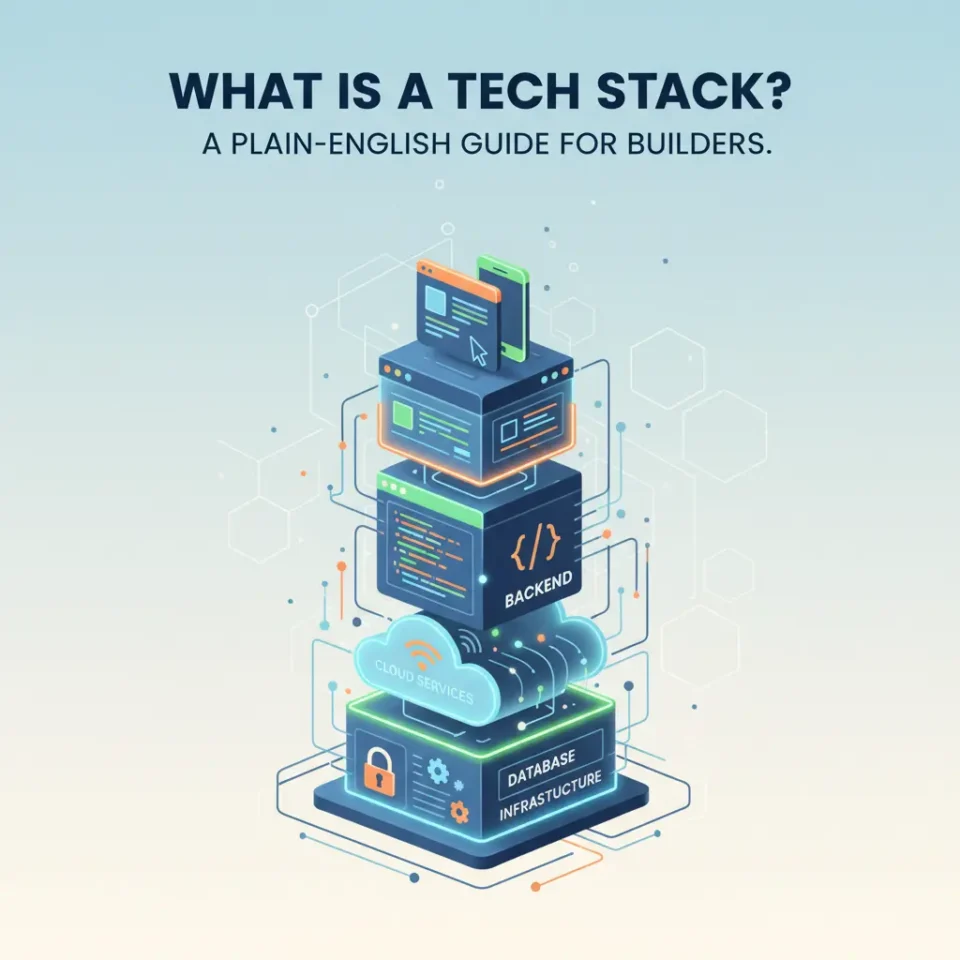
Most tech stacks are divided into two main layers:
- The frontend (client-side): Everything the user sees and interacts with—buttons, layouts, animations, forms.
- The backend (server-side): The logic running behind the scenes—databases, servers, authentication, and APIs.
Together, these layers form a complete system. A user clicks a button on the frontend; the backend processes the request, retrieves data, and sends a response back. The whole exchange happens in milliseconds.
The Core Components of a Tech Stack
Frontend Technologies
The frontend is built using three foundational web technologies: HTML, CSS, and JavaScript. HTML structures the content, CSS styles it, and JavaScript makes it interactive.
Most modern teams don’t write plain JavaScript—they use frameworks and libraries that speed up development. The most widely adopted options include:
- React (Meta) — A component-based library known for flexibility and a massive ecosystem
- Vue.js — Lightweight, beginner-friendly, and great for smaller applications
- Angular (Google) — A full-featured framework favored in enterprise environments
Backend Technologies
The backend handles data, business logic, and communication between the frontend and the database. Common backend languages and frameworks include:
- Node.js — JavaScript on the server side, popular for real-time applications
- Python with Django or Flask — Readable syntax, strong in data-heavy and AI-driven apps
- Ruby on Rails — Convention-heavy framework that prioritizes developer speed
- Java with Spring — Robust and scalable, common in large enterprise systems
- PHP with Laravel — Still widely used for content-heavy websites and e-commerce
Databases
Every application needs a place to store data. The two main categories are:
- Relational databases (SQL): Structured data stored in tables. Examples: PostgreSQL, MySQL, SQLite.
- Non-relational databases (NoSQL): Flexible, document-based storage. Examples: MongoDB, Firebase, DynamoDB.
The choice between SQL and NoSQL usually depends on how structured your data is and how much it might change over time.
Infrastructure and DevOps
Modern applications also rely on hosting platforms, cloud services, and deployment tools. AWS, Google Cloud, and Microsoft Azure dominate this space. Tools like Docker, Kubernetes, and CI/CD pipelines help teams ship code faster and more reliably.
Popular Tech Stack Examples
A few combinations have become particularly common in the industry:
MERN Stack
MongoDB, Express.js, React, Node.js. A fully JavaScript stack—popular with startups because one language is used across the entire application.
LAMP Stack
Linux, Apache, MySQL, PHP. One of the oldest and most battle-tested stacks, still powering a huge share of the web.
JAMstack
JavaScript, APIs, and Markup. A modern, performance-focused architecture that separates the frontend from backend services. Great for static sites and content-driven applications.
T3 Stack
A newer, TypeScript-first stack combining Next.js, Prisma, and tRPC. Growing in popularity among developers who prioritize type safety and developer experience.
How to Choose the Right Tech Stack
Picking a tech stack isn’t just a technical decision—it’s a strategic one. Here’s what to consider:
Your Team’s Existing Skills
The fastest stack is the one your team already knows. Learning a new framework mid-project adds time, risk, and cost. If your engineers are strong in Python, a Python-based backend will serve you better than rewriting everything in Go—even if Go looks attractive on paper.
The Nature of Your Application
Different applications have different demands. A real-time chat app needs low latency and persistent connections—something Node.js handles well. A machine learning platform might lean heavily on Python. A marketing site with high traffic benefits from a static site approach like JAMstack.
Scalability Requirements
If you expect rapid growth, choose a stack that scales without requiring a full rewrite. Cloud-native architectures and microservices make it easier to scale individual components independently rather than the whole system at once.
Community and Ecosystem
Larger communities mean better documentation, more third-party integrations, and faster access to solutions when something breaks. React, for instance, has an enormous ecosystem—almost any UI problem you encounter will have an existing solution.
Long-Term Maintenance
Trendy tools come and go. Before committing to a technology, check how actively it’s maintained, who’s backing it, and how it’s been adopted at scale. A stack built on abandoned or niche tools becomes a liability over time.
Tech Stack Mistakes to Avoid
A few common missteps can derail even well-intentioned teams:
Over-engineering early on. Startups sometimes build complex microservices architectures before they have the user base to justify it. A simpler monolith is easier to build, debug, and maintain—until scale actually demands more.
Choosing technology for résumé value. Engineers occasionally push for newer or flashier tools because they want to learn them. That’s understandable, but the product’s needs should drive technical decisions.
Ignoring vendor lock-in. Relying too heavily on a single cloud provider or proprietary service can make it expensive or painful to switch later. Build with portability in mind where it matters.
Neglecting security from the start. Security is easier to bake in than bolt on. Authentication, data encryption, and input validation should be part of your stack decisions from day one.
Your Tech Stack Will Evolve—And That’s Fine
No tech stack is permanent. Companies like Twitter, Airbnb, and Shopify have rewritten significant parts of their systems as they scaled. What matters early on is shipping, learning, and iterating—not finding the perfect stack before you’ve written a single line of code.
Start with what your team knows, match your tools to your use case, and build in a way that lets you adapt as requirements change. The right stack for your project today may look very different from the right stack two years from now. That’s not a failure—it’s how good engineering works.
