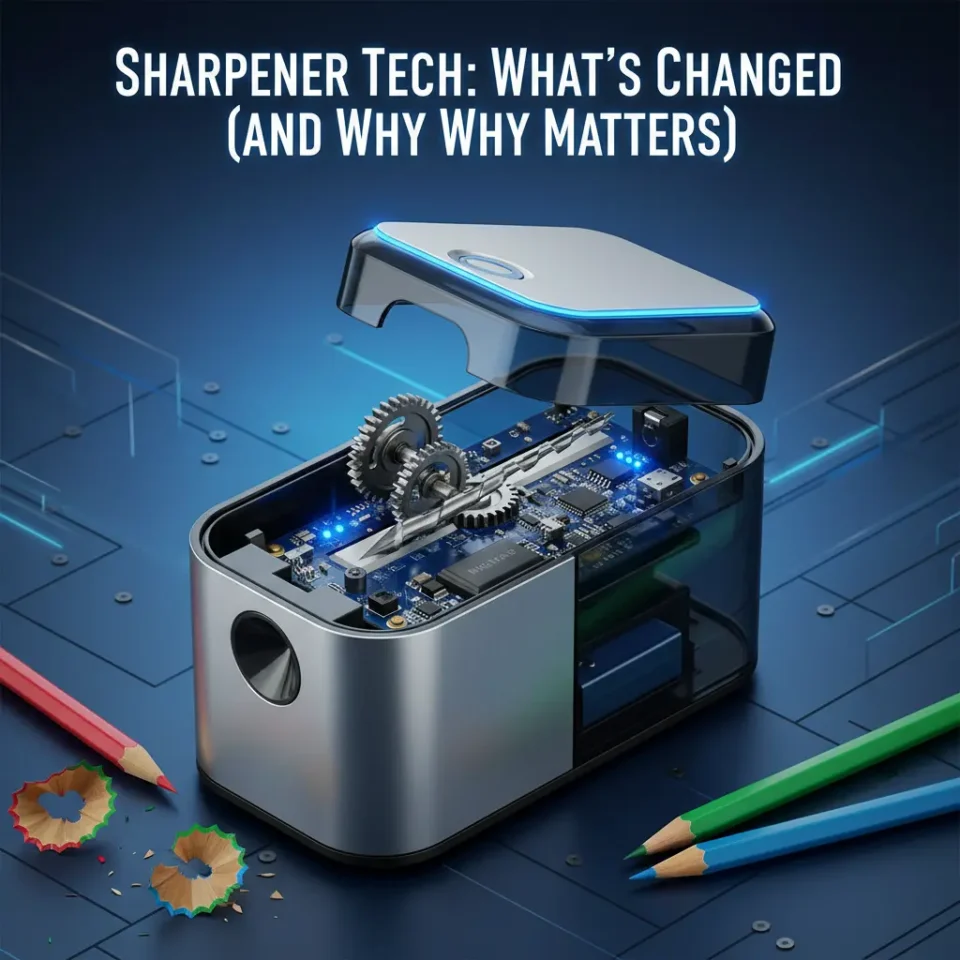
A dull blade is a dangerous blade. That’s a lesson woodworkers, chefs, and surgeons have known for centuries. But while the principle hasn’t changed, the technology behind sharpening has evolved dramatically—from hand-held whetstones to precision electric systems that would look at home in a laboratory.
Sharpener tech sits at a curious crossroads of craft and innovation. Whether it’s a kitchen knife, a pencil, or a surgical scalpel, the tools we use to maintain sharp edges have quietly undergone a revolution. Understanding how modern sharpening technology works—and what separates a great tool from a mediocre one—can save time, money, and frustration in equal measure.
The Core Principle Behind Every Sharpener
Before exploring the technology, it helps to understand what sharpening actually does. Every blade or point has a cutting edge formed by two surfaces meeting at an angle. Over time, that edge rolls over, chips, or wears down through use. Sharpening removes microscopic amounts of material to restore that angle and create a clean, functional edge.
The challenge? Removing too much material shortens the life of the tool. Remove too little, and you haven’t fixed the problem. The best sharpener tech finds the sweet spot—efficiently restoring an edge without degrading it.
From Whetstones to Smart Systems: A Brief History
Sharpening is ancient. Early humans used flat stones to sharpen flint tools thousands of years ago. The whetstone—a rectangular block of abrasive material used with water or oil—remained the standard for most of recorded history.
The first mechanical sharpeners appeared in the late 19th century, primarily for pencils. These hand-cranked devices used a rotating burr to grind pencil tips to a consistent point. By the mid-20th century, electric versions became household staples.
The knife sharpening industry followed a similar arc. Bench grinders and handheld pull-through sharpeners brought speed and convenience to what had once been a skilled manual task. But it wasn’t until the past decade or so that sharpener technology truly entered a new era.
What Modern Sharpener Tech Actually Looks Like
Today’s sharpening tools range from beautifully refined manual instruments to sophisticated electric systems with built-in angle guides, multi-stage abrasion, and even digital feedback.
Electric Knife Sharpeners
High-end electric knife sharpeners now feature multiple sharpening stages—typically coarse, medium, and fine—each using progressively finer abrasives to restore and then polish an edge. Brands like Work Sharp, Chef’sChoice, and KitchenIQ have built dedicated followings among professional chefs and home cooks alike.
The more advanced models use flexible abrasive belts rather than rigid grinding wheels. This matters because belts conform slightly to the blade, producing a more even edge with less risk of overheating the metal—a real concern, since excessive heat can soften the steel and ruin a blade’s temper.
Some systems now incorporate angle-control technology, automatically adjusting the grinding angle based on the type of knife being sharpened. Japanese knives, for example, typically use a more acute angle (around 15 degrees) compared to Western-style knives (20–25 degrees). Getting this right by hand requires skill; letting a machine handle it removes the guesswork entirely.
Pencil Sharpeners
Pencil sharpener technology has seen its own quiet advancement. For artists, architects, and designers who rely on precise, consistent points, the difference between a budget sharpener and a high-quality one is immediately noticeable.
German-engineered sharpeners from brands like Faber-Castell and Staedtler use hardened steel blades and precision-machined chambers to produce clean, centered points with minimal wood tear. Electric versions designed for professional use offer adjustable point lengths and automatic shut-off to prevent over-sharpening.
At the commercial end, industrial electric sharpeners used in schools and offices now feature helical steel cutters—a design borrowed from metalworking—which produce a more uniform cut and last significantly longer than traditional flat-blade designs.
Specialty Sharpening Systems
Beyond knives and pencils, sharpener technology extends into a surprising range of fields:
- Surgical and medical instruments: Precision sharpening systems maintain the edge geometry of scalpels, scissors, and curettes to exacting tolerances. Even minor deviations can affect performance in clinical settings.
- Woodworking tools: Chisels, plane blades, and carving tools require flat, polished backs and perfectly angled bevels. Guided honing systems, like those from Veritas and Tormek, use water-cooled grinding wheels and adjustable jigs to achieve repeatability that would take years of practice to replicate freehand.
- Sports equipment: Ski edge sharpeners and ice skate sharpening machines use diamond-coated tools and guided rails to restore precise edge geometry, directly affecting performance on snow and ice.
The Role of Abrasive Materials
No conversation about sharpener tech is complete without discussing abrasives. The material doing the actual cutting has evolved considerably.
Traditional sharpening stones used natural materials like novaculite (Arkansas stone) or Japanese water stones. These remain popular among purists for the control they offer, but modern synthetic alternatives have raised the bar considerably.
Aluminum oxide is the workhorse of the sharpening world—affordable, durable, and effective for most metals. Silicon carbide cuts faster and is better suited to very hard materials. Diamond abrasives, once reserved for industrial applications, are now widely available in consumer tools. Diamond sharpeners maintain their flatness far longer than conventional stones and work exceptionally well on harder modern steels, including the high-carbon and powdered-metallurgy alloys used in premium knives.
Ceramic abrasives occupy a middle ground—harder than aluminum oxide but finer in grit, making them ideal for the finishing and honing stages of sharpening.
Choosing the Right Sharpener
With so many options available, choosing the right sharpening system comes down to a few key questions:
What are you sharpening? Kitchen knives, woodworking tools, and pencils all have different requirements. A multi-stage electric knife sharpener is useless for a chisel. A sharpening stone designed for chisels won’t help much in the kitchen.
How often will you use it? Occasional home use and daily professional use call for very different tools. High-volume environments benefit from electric systems with longer-lasting abrasives and faster throughput.
How much control do you want? Guided systems and electric sharpeners prioritize consistency and ease of use. Manual stones and strops reward skill and patience with an arguably superior result—but only in the right hands.
What’s your budget? Entry-level electric sharpeners start around $30–$50 and handle most everyday tasks competently. Professional-grade systems can run into the hundreds or even thousands of dollars, but for serious users, the investment pays off quickly in tool longevity and performance.
The Future of Sharpening Technology
The next frontier in sharpener tech is precision feedback. A few brands are already experimenting with sensors that detect edge geometry in real time, adjusting sharpening pressure and angle automatically. Laser-guided systems for professional knife sharpening have appeared in commercial kitchens, promising perfectly consistent results with minimal operator skill required.
AI-assisted sharpening systems—where a camera or sensor analyzes the current state of a blade and recommends or executes a sharpening protocol—are likely not far behind. Given how much technology has already changed what was once a purely manual craft, that kind of integration feels like a natural next step.
Keep Your Edge
Sharp tools perform better, last longer, and are significantly safer to use than dull ones. That holds true across every application, from slicing vegetables to carving wood to sketching with a freshly pointed pencil.
Investing in quality sharpener technology—and understanding what to look for—is one of the simplest ways to extend the life of your tools and improve your results. Start by identifying what you’re sharpening most often, then match the technology to the task. A good sharpening system, used consistently, pays for itself many times over.
