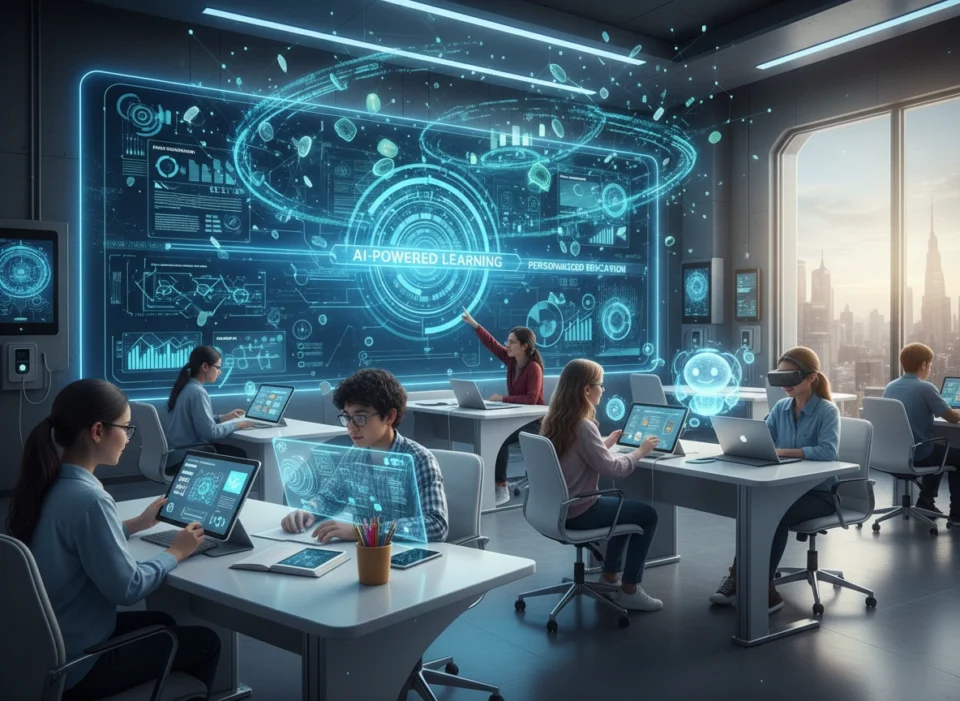
Artificial intelligence is reshaping industries, and the classroom is no exception. Far from being a futuristic concept, AI is actively changing how students learn, how teachers instruct, and how educational institutions operate. This technology offers a pathway to more personalized, efficient, and accessible education for learners worldwide. By automating tasks and providing deep insights into student performance, AI empowers educators to focus on what matters most: fostering critical thinking and genuine understanding.
This article will explore the transformative role of AI in modern education. We will examine how it enables personalized learning paths, streamlines administrative duties, and breaks down barriers to access. We will also consider the challenges and ethical questions that accompany its integration, along with a look at what the future holds for AI in the classroom.
Personalizing the Learning Journey
One of the most significant impacts of AI in education is its ability to create truly personalized learning experiences. Traditional classroom models often struggle to cater to the diverse needs of every student. AI-powered platforms can adapt to individual learning paces and styles, creating a more effective and engaging educational environment.
Adaptive Learning Platforms
Adaptive learning systems use AI algorithms to adjust the curriculum in real-time based on a student’s performance. If a student masters a concept quickly, the system can introduce more advanced topics. Conversely, if a student is struggling, the AI can provide additional resources, practice exercises, or alternative explanations to reinforce understanding.
Platforms like Khan Academy and DreamBox Learning use this technology to great effect. They analyze student responses to identify knowledge gaps and strengths. This data allows the software to present the right content at the right time, ensuring that each student is appropriately challenged without feeling overwhelmed. This customized approach helps build confidence and fosters a deeper mastery of the subject matter.
Intelligent Tutoring Systems
Intelligent Tutoring Systems (ITS) act as virtual one-on-one tutors. These AI-driven programs guide students through problem-solving exercises, offering hints and feedback along the way. Unlike a static textbook, an ITS can simulate a human tutor’s approach by asking probing questions and encouraging students to arrive at the solution independently.
For example, a student learning algebra might receive step-by-step guidance from an ITS as they solve an equation. The system can detect common errors and provide targeted feedback to correct misunderstandings immediately. This instant, personalized support is invaluable, especially in large classrooms where a teacher’s time is limited.
Streamlining Educational Administration
Beyond student-facing applications, AI is also revolutionizing the administrative side of education. Teachers and administrators are often burdened with repetitive tasks that take time away from instruction and strategic planning. AI tools can automate many of these duties, leading to greater efficiency and a renewed focus on educational outcomes.
Automating Grading and Assessment
Grading assignments, especially for large classes, can be a time-consuming process. AI can automate the grading of multiple-choice questions, fill-in-the-blank answers, and even more complex written responses. AI-powered grading tools use natural language processing (NLP) to analyze essays for grammar, syntax, and content, providing quick and consistent feedback.
This automation frees up teachers to concentrate on more nuanced aspects of student evaluation, such as creativity and critical analysis. It also provides students with faster feedback, allowing them to learn from their mistakes while the material is still fresh in their minds.
Enhancing Institutional Efficiency
At an institutional level, AI can optimize resource allocation, scheduling, and admissions processes. AI algorithms can analyze historical data to predict student enrollment trends, helping universities plan for faculty and facility needs more effectively. In admissions, AI can help screen thousands of applications by identifying candidates who meet specific criteria, allowing admissions officers to focus on a more holistic review of qualified applicants. This leads to a more efficient and equitable process for both the institution and the prospective students.
Increasing Accessibility and Inclusivity
AI technology holds immense promise for making education more accessible to all learners, including those with disabilities. By providing alternative ways to access and interact with content, AI is helping to create more inclusive learning environments.
Tools that provide real-time transcription and translation are breaking down language and hearing barriers. For students who are deaf or hard of hearing, AI-powered software can convert spoken lectures into written text. Similarly, students who are non-native speakers can benefit from instant translations, ensuring they do not fall behind.
For visually impaired students, AI can describe images and graphs in textbooks, making visual content accessible. Text-to-speech technology allows students to listen to written materials, while voice-command tools enable them to navigate digital platforms and complete assignments without relying on a traditional keyboard or mouse. These innovations ensure that every student has the opportunity to participate fully in their education.
Challenges and Ethical Considerations
The integration of AI into education is not without its challenges and ethical dilemmas. One of the primary concerns is data privacy. AI systems collect vast amounts of data on student performance and behavior. It is crucial to have robust security measures and clear policies in place to protect this sensitive information from misuse or breaches.
Another significant concern is algorithmic bias. If the data used to train AI models reflects existing societal biases, the technology could perpetuate or even amplify inequities. For example, an AI grading system trained on a limited set of writing styles might unfairly penalize students from different cultural or linguistic backgrounds. Developers and educators must work together to ensure that AI tools are fair, transparent, and equitable.
Furthermore, there is a risk of over-reliance on technology. While AI can be a powerful tool, it cannot replace the human connection that is central to effective teaching. Mentorship, empathy, and the ability to inspire are uniquely human qualities. A balanced approach is necessary, one where AI supports educators rather than seeking to replace them.
The Future of AI in Education
Looking ahead, the role of AI in education is set to expand even further. We can expect to see more sophisticated and immersive learning experiences powered by technologies like virtual reality (VR) and augmented reality (AR). Imagine biology students taking a virtual tour of the human circulatory system or history students walking through an AI-reconstructed ancient city.
AI will also likely play a larger role in curriculum development. By analyzing data on which teaching methods are most effective for different subjects and student populations, AI can help educators design more impactful and engaging lesson plans. Lifelong learning will also be transformed, with AI platforms offering personalized professional development and upskilling opportunities tailored to an individual’s career goals and existing knowledge.
Conclusion
Artificial intelligence is already making a profound impact on modern education. From creating personalized learning paths for students to streamlining administrative tasks for educators, its benefits are wide-ranging. AI is also playing a critical role in making education more accessible and inclusive for learners of all abilities.
However, as we embrace these new technologies, we must proceed with caution. Addressing challenges related to data privacy, algorithmic bias, and the importance of the human element is essential for responsible implementation. By navigating these issues thoughtfully, we can harness the full potential of AI to create a more effective, equitable, and engaging educational landscape for generations to come. The goal is not to replace teachers but to empower them with tools that enhance their ability to educate and inspire.
Please visit this website for more info.
